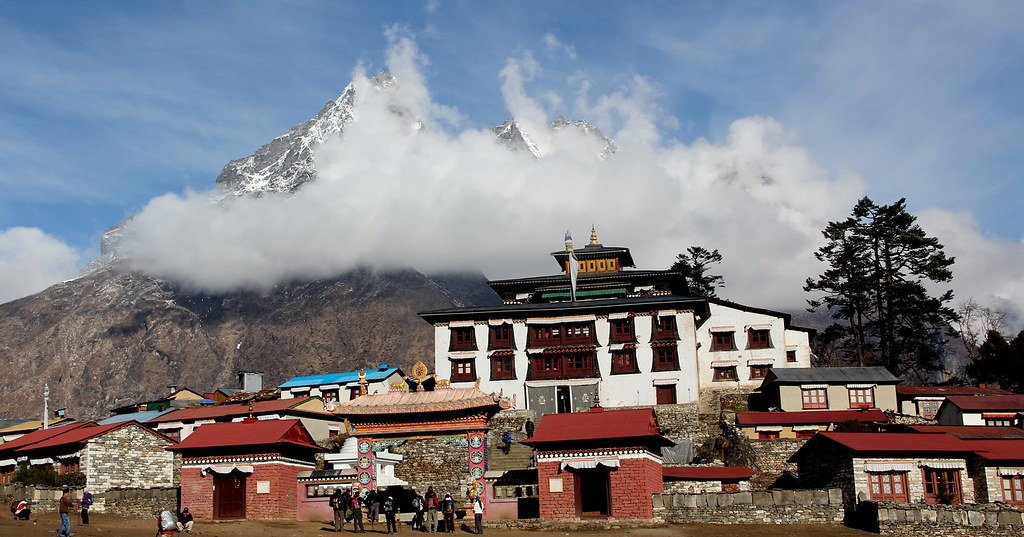
High in the Khumbu region of Nepal, where the air grows thin and snow-capped peaks pierce the sky, stands Tengboche Monastery. Surrounded by a panoramic sweep of the Himalayan mountains, including the legendary Mount Everest, Nuptse, Lhotse, and the iconic Ama Dablam, this spiritual haven anchors the Sherpa community and welcomes weary travelers. Known locally as Dawa Choling Gompa, it is the largest gompa in the Everest region.
We journey to this sacred site not just for the mountain views, but to understand a way of life deeply intertwined with nature and spirituality. Tengboche Monastery offers a profound sense of peace. It serves as a vital resting point, a place of blessing, and a vibrant center of Tibetan Buddhism.
The Stunning Location and Landscape
Tengboche Monastery rests on a hill at the confluence of the Dudh Kosi and Imja Khola rivers. At an elevation of 3,867 meters (12,687 feet), the journey to reach it demands physical effort and respect for the altitude. The village of Tengboche itself is small, existing almost entirely to support the monastery and the trekkers passing through.
When you stand in the monastery courtyard, the landscape commands your attention. Pine forests, rhododendrons, and azaleas cover the lower slopes, creating a striking contrast against the barren, icy peaks above. This setting is not an accident. According to local belief, Lama Sangwa Dorje, a highly revered Buddhist figure, foresaw the creation of a monastery here centuries ago. He left his footprint on a stone that remains near the monastery today, marking the site as holy ground long before the first stone was laid.
A Glimpse into History
The physical foundation of Tengboche Monastery dates back to 1916. Lama Gulu, also known as Chatang Chotar, established the gompa under the guidance of the Rongbuk Monastery in Tibet. He recognized the spiritual need for a central place of worship for the Sherpa people of the Khumbu valley.
The monastery has faced severe trials over the past century. In 1934, a devastating earthquake struck the region, leaving the original structure in ruins. Lama Gulu passed away shortly after, but his successor, Umze Gelden, took up the mantle and rebuilt the gompa with the help of the local community and skilled carpenters from Lhasa.
Tragedy struck again on a cold January night in 1989. An electrical short circuit sparked a massive fire. The wooden structures caught quickly, and despite the frantic efforts of monks and locals, the blaze consumed the main building. Many ancient scriptures, intricate thangkas (religious paintings), and historic artifacts were lost to the flames.
Yet, the spirit of Tengboche remained unbroken. The global mountaineering community, recognizing the monastery’s importance, rallied to help. Sir Edmund Hillary, who held a deep affection for the Sherpa people, played a crucial role in raising funds through the Himalayan Trust. Today, the rebuilt monastery stands as a testament to resilience, blending traditional architecture with modern safety enhancements.
Cultural and Spiritual Significance
Tengboche follows the Nyingma tradition of Tibetan Buddhism, the oldest of the four major schools. The spiritual life here revolves around compassion, mindfulness, and the pursuit of enlightenment.
For the Sherpa community, Tengboche is the spiritual heart of their homeland. Sherpas are predominantly Buddhist, and their faith dictates their relationship with the mountains. They view the towering peaks not as objects to conquer, but as the dwelling places of gods and protective deities. Mount Everest, known to them as Chomolungma, translates to “Goddess Mother of the World.”
Before embarking on any major expedition, climbers and Sherpas alike visit Tengboche to seek blessings from the Rinpoche (the head lama). They light butter lamps, offer prayers, and ask for safe passage through the dangerous icefalls and unpredictable weather of the high Himalayas. This ritual connects the physical challenge of climbing with a deep spiritual reverence.
Architectural Brilliance
Approaching Tengboche, the first thing you notice is the striking gateway, decorated with intricate carvings and vibrant colors. The architecture follows traditional Tibetan designs, built primarily from stone and wood, and built to withstand the harsh alpine environment.
The Main Courtyard
The central courtyard serves as the focal point for festivals and public gatherings. A large prayer pole stands in the middle, draped in colorful prayer flags that send mantras into the wind.
The Dokhang (Main Prayer Hall)
The most sacred space is the Dokhang. When you step inside, the scent of burning juniper and butter lamps fills the air. The walls feature magnificent, newly restored murals depicting the life of the Buddha, various bodhisattvas, and the Wheel of Life. These paintings serve as visual scriptures, teaching the path to enlightenment.
At the front of the hall sits a towering, gilded statue of Shakyamuni Buddha. Flanking the Buddha are statues of Guru Rinpoche (Padmasambhava) and Chenrezig (the Buddha of Compassion). Monks sit on low cushions arranged in rows, chanting scriptures accompanied by the deep resonance of traditional horns, cymbals, and drums.
The Eco-Center
In recent years, the monastery has embraced sustainability. The Tengboche Eco-Centre promotes environmental awareness among locals and visitors. It addresses issues like waste management, deforestation, and the impact of climate change on the fragile Himalayan ecosystem.
The Mani Rimdu Festival
If you want to experience Tengboche at its most vibrant, plan your visit during the Mani Rimdu festival. Held annually in October or November (following the Tibetan lunar calendar), this nineteen-day festival celebrates the founding of Buddhism in Tibet by Guru Rinpoche.
Only the final three days are open to the public, drawing massive crowds of locals and tourists.
The Preparation
The monks spend days preparing a complex sand mandala, an intricate design made from colored sand. This mandala represents the palace of Garwang Toze Chenpo, the Lord of the Dance. Monks chant prayers over the mandala, infusing it with spiritual energy.
The Cham Dances
The highlight of Mani Rimdu is the series of Cham dances. Monks wear elaborate brocade robes and finely crafted, often terrifying wooden masks representing various deities, demons, and historical figures. The dances are not mere entertainment; they are spiritual exercises that enact the triumph of Buddhism over malevolent forces. The rhythmic stomping, the clash of cymbals, and the swirling colors create a mesmerizing spectacle.
The Fire Puja and Blessing
The festival concludes with a fire puja (offering) to appease the fire god, Agni. The monks distribute blessed pills (Mani Rilwu) to the attendees, believed to grant long life and good fortune. Finally, in a poignant reminder of impermanence, the monks dismantle the sand mandala and sweep the sand into the river, allowing the blessings to flow through the valleys below.
Practical Guide for Visitors
Visiting Tengboche requires preparation. It is not a place you can simply drive to; getting there is an adventure in itself.
How to Get There
Your journey begins with a thrilling flight from Kathmandu to Tenzing-Hillary Airport in Lukla. From Lukla, you will trek through the Dudh Kosi valley. The standard route takes you through Phakding and up to the bustling Sherpa capital of Namche Bazaar (3,440 meters).
Most trekkers spend a day or two in Namche to acclimatize. The trek from Namche to Tengboche takes about five to six hours. The trail descends to the river at Phunki Tenga before a steep, demanding ascent through a dense rhododendron forest brings you to the monastery gates.
Best Time to Visit
The optimal times to visit are during the spring (March to May) and autumn (September to November).
Spring: The weather is relatively mild, and the forests burst into color with blooming rhododendrons.
Autumn: The skies are generally clear, offering the most spectacular mountain views. This season also aligns with the Mani Rimdu festival.
Winter brings heavy snow and freezing temperatures, while the summer monsoon obscures the mountains in clouds and brings leeches to the lower trails.
Etiquette and Tips for a Meaningful Experience
When visiting a sacred site like Tengboche, respect is paramount.
Dress Modestly: Wear clothing that covers your shoulders and knees. Remove your hat and shoes before entering the main prayer hall.
Walk Clockwise: Always walk clockwise around the monastery exterior, chortens (shrines), and mani walls (walls of carved prayer stones). Spin prayer wheels in a clockwise direction.
Photography Rules: Photography is usually prohibited inside the main prayer hall. Always ask for permission before taking close-up photos of the monks.
Mind the Altitude: At nearly 3,900 meters, altitude sickness is a real risk. Walk slowly, stay hydrated, and listen to your body.
Silence: Maintain a quiet, respectful demeanor, especially when monks are chanting.
Reflections on a Spiritual Journey
Tengboche Monastery is more than a building on a hill; it is a living, breathing testament to human resilience and spiritual devotion. In a landscape that reminds us of our own smallness, the monastery provides a space for reflection and connection.
Whether you are a seasoned mountaineer seeking a safe passage to the summit of Everest, or a trekker looking for a moment of quiet contemplation, Tengboche leaves a lasting mark. The sound of the morning horns, the sight of the butter lamps flickering in the dimly lit hall, and the warmth of the Sherpa people combine to create an experience that transcends ordinary travel. It reminds us that even in the harshest environments, faith and community can thrive.
Frequently Asked Questions
1. What is Tengboche Monastery?
Tengboche Monastery is the largest and most important Buddhist monastery in the Khumbu region of Nepal. It serves as the spiritual center for the local Sherpa community and a major landmark for trekkers and climbers heading to Mount Everest.
2. Who founded Tengboche Monastery?
Lama Gulu (Chatang Chotar) founded the monastery in 1916.
3. What school of Buddhism does Tengboche follow?
The monastery follows the Nyingma tradition, which is the oldest of the four major schools of Tibetan Buddhism.
4. Has the monastery ever been destroyed?
Yes, twice. An earthquake destroyed the original structure in 1934, and a massive fire burned down the rebuilt structure in 1989.
5. How was the monastery rebuilt after the 1989 fire?
The local community, monks, and the international mountaineering community—spearheaded by Sir Edmund Hillary’s Himalayan Trust—raised funds and provided labor to rebuild the monastery.
6. Who is the head of Tengboche Monastery?
The monastery is led by a reincarnate lama known as the Tengboche Rinpoche.
7. Why is Tengboche important to mountain climbers?
Climbers and Sherpas stop at the monastery to receive blessings from the Rinpoche. They pray for good health, safe passage, and success before attempting to summit Mount Everest or other peaks in the region.
8. What is the significance of the footprint on the stone near the monastery?
According to legend, Lama Sangwa Dorje left his footprint on a rock in Tengboche centuries ago, marking the site as sacred ground long before the monastery was built.
Location and Logistics
9. Exactly where is Tengboche Monastery located?
It is located in the Tengboche village in the Khumbu (Everest) region of eastern Nepal, situated on a ridge above the confluence of the Dudh Kosi and Imja Khola rivers.
10. What is the elevation of Tengboche Monastery?
The monastery sits at an elevation of 3,867 meters (12,687 feet) above sea level.
11. Can I drive to Tengboche Monastery?
No. There are no roads to Tengboche. You must trek to reach the monastery.
12. How long does it take to trek to Tengboche?
From the starting point in Lukla, it typically takes four to five days of trekking, including a necessary acclimatization day in Namche Bazaar.
13. What mountains can I see from the monastery?
On a clear day, you can see Mount Everest, Lhotse, Nuptse, Tawache, and the striking peak of Ama Dablam.
14. Are there places to stay near the monastery?
Yes, the village of Tengboche has several teahouses and lodges that accommodate trekkers. Nearby villages like Deboche also offer lodging options.
15. Is altitude sickness a risk at Tengboche?
Yes. At 3,867 meters, the air has significantly less oxygen. Proper acclimatization in Namche Bazaar is crucial before ascending to Tengboche.
Visiting Rules and Etiquette
16. Can anyone visit Tengboche Monastery?
Yes, the monastery is open to visitors of all faiths and backgrounds.
17. What are the visiting hours?
The monastery generally opens in the early morning and closes in the late afternoon. Visitors are usually welcome between 7:00 AM and 4:00 PM, though times can vary during festivals or private rituals.
18. Do I need to pay an entrance fee?
While there is no strict entrance fee, a small donation is highly encouraged and appreciated to help maintain the monastery and support the monks.
19. What should I wear when visiting?
Dress modestly. Avoid shorts and tank tops. Wear long pants and shirts that cover your shoulders. You must also remove your hat and shoes before entering the main prayer hall.
20. Can I take photographs inside the monastery?
Photography is strictly prohibited inside the main prayer hall (Dokhang). You can take photos in the exterior courtyard, but always ask permission before taking pictures of the monks.
21. How should I interact with prayer wheels and stupas?
Always walk clockwise around stupas, shrines, and the monastery itself. Spin prayer wheels in a clockwise direction using your right hand.
22. Can I attend a prayer session?
Yes, visitors can sit quietly in the back of the hall during the daily morning or afternoon prayer sessions. Maintain absolute silence and respect the monks’ space.
Festivals and Activities
23. What is the Mani Rimdu festival?
Mani Rimdu is the most important annual festival at Tengboche, lasting 19 days. It features masked dances, prayers, and feasts to celebrate the founding of Buddhism in Tibet.
24. When does Mani Rimdu take place?
It takes place in the 9th Tibetan month, which usually falls in October or November of the Gregorian calendar. The exact dates change every year.
25. Can tourists attend the Mani Rimdu festival?
Yes, the final three days of the festival are open to the public and are a major attraction for trekkers.
26. What do the masked dances represent?
The dances (Cham) enact the triumph of positive spiritual forces over demons and negative energies.
27. What is a sand mandala?
During Mani Rimdu, monks create a complex, colorful geometric design out of colored sand. It represents the palace of a deity and is destroyed at the end of the festival to symbolize impermanence.
Monastic Life and Surroundings
28. How many monks live at Tengboche?
The number fluctuates, but there are typically around 60 monks residing at the monastery.
29. What is the Tengboche Eco-Centre?
It is a facility linked to the monastery that promotes sustainable practices, safe drinking water, and environmental conservation in the Khumbu region.
30. What is the next major stop on the trek after Tengboche?
For those heading to Everest Base Camp, the trail usually descends to Deboche, crosses the river, and climbs up to the village of Dingboche (4,410 meters).